Slow Travel in Greece

Caminos to Rome: A Slow Trip to the Eternal City, full of light and wonder

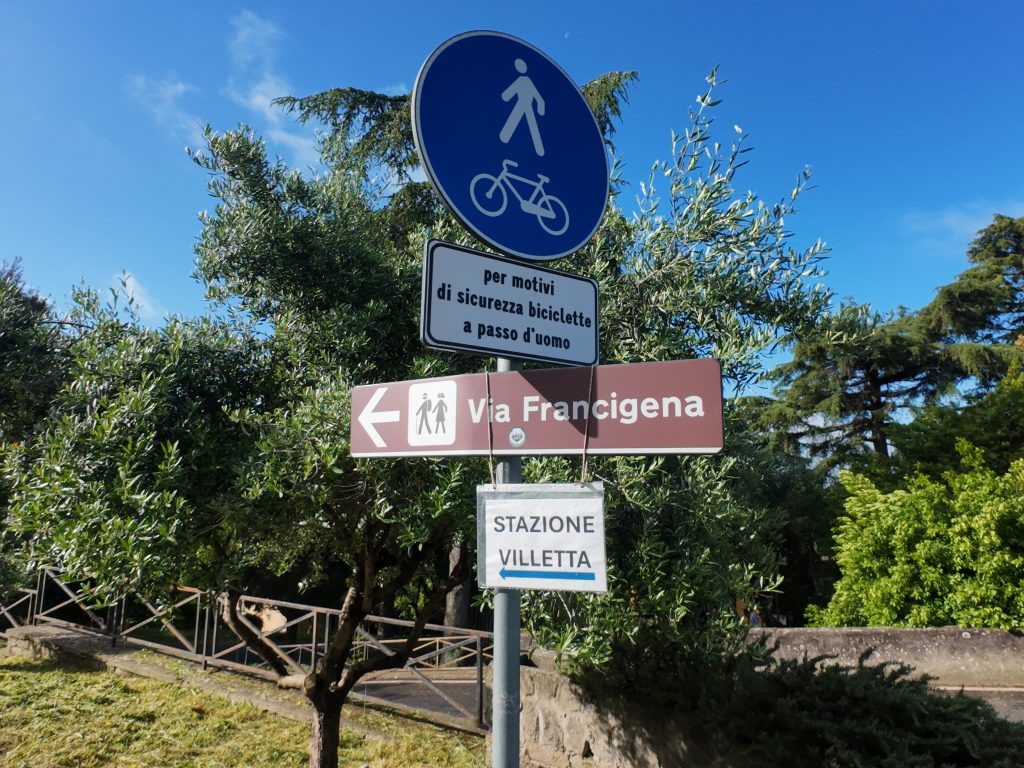
Via Francigena signs on road hiking paths
Slow Travelling in Italy

Caminos to Rome: A Slow Trip to the Eternal City, full of light and wonder

A journey into Italy’s Slow Travel spirit, the birthplace of the Slow Travel movement.

“I need to know the history of what I eat, not only the price. I need to know where it comes from, the hands that farmed and produced it… The day food has lost its true value and its history, there will be no hope for the future.” Carlo Petrini, Slow Food President

SLOW TRAVEL TO ROME

As Petrini emphasized about the origins and history of the food that reaches our tables, the same idea applies to Slow Travel: the journey itself becomes part of the destination, and the routes we follow along the way are just as important as our arrival point.
The paths we walk, the landscapes we cross, the stories and history behind them, the ways we move, the food and drinks we taste, the understanding we gain of the host society, and the positive contribution we leave behind, all of these define the wholesome travel experience, allowing us to connect with local culture in meaningful ways and deeper ways.
I was fortunate, in May 2025, to live this philosophy in the birthplace of the Slow Movement, walking the Caminos to Rome.
The Jubilee Year 2025
and the Caminos to Rome

WALKING THE VIA FRANCIGENA IN THE JUBILEE YEAR 2025

The ancient pilgrimage trails to Rome have been restored by the European Association of Via Francigena Ways and prepared to welcome travelers who seek a slower, more spiritual journey, and they form part of the wider European Cultural Routes network.

Pilgrims who complete at least 100 kilometers of the journey are eligible to receive the Testimonium, a certificate recognizing the journey to the Apostles’ tombs and participation in the Jubilee.

The Testimonium certificate can be collected at the official Jubilee InfoPoint on Via della Conciliazione 7 in Rome. More information you can read here.

default

In the Jubilee Year 2025, countless pilgrims are already setting out on foot toward Rome, following the traditional Jubilee pilgrimage routes. 

Paths such as the Via Francigena, the southern branch of the Via Francigena, and the the Way of St. Francis or Via di Francesco all converge at Porta Santa, the Holy Door of St. Peter’s Basilica in the Vatican.

default
Here, two volcanic lakes shape the scenery: the small, enchanting Lake Nemi and the larger, oval-shaped Lake Albano. Overlooking the latter is the town of Castel Gandolfo, famed for its papal summer residence where many popes have spent their summers since the 17th century.
This volcanic heart of the Lazio region, southeast of the capital, has long captivated the interests of the residents of the Eternal City, with its charm reflecting in the grand papal and noble residences that still dominate the landscape.
IMG_20250521_090653

A holistic Slow Travel journey through pilgrim paths and volcanic lakes

On Tuesday, May 20th, my journey began with a flight from Thessaloniki to Rome, followed by a 45-minute train ride to Castel Gandolfo in the Colli Albani hills, better known collectively as the Castelli Romani area.

I was thrilled to embark from this historic setting on a 4-day walking journey, tracing the ancient paths of the Via Francigena, the Francigena del Sud, and the Via di Francesco, all the way to Rome and St. Peter’s Basilica. Our route carried us through villages, forests, lakeshores, and quiet country lanes, each step bringing us closer to Rome and the Vatican. This journey was part of the Cammini verso Roma press trip, beautifully organized by Sloways and the European Association of Via Francigena Ways (EAVF).

Each day of our journey unfolded like a chapter in a personal, living storybook. From the very first steps to the final footsteps, our path left the lightest possible ecological footprint while offering a truly holistic slow travel experience. The following four days of storytelling capture glimpses of this journey and the moments that made it unforgettable.
Day 1
A taste of Italian hospitality and Castelli cuisine

Our first day started with a warm welcome at the Hotel Castel Vecchio in Grand Gadolfo, overlooking Lake Albano, Italy’s deepest volcanic lake. The hotel is ideally situated amphitheatrically around the lake and the view of it is stunning and relaxing, the ideal start for a slow trip adventure.

The well-equipped rooms and its impeccable, luxurious aesthetic, especially the dining area next to the reception, gave us an extra touch of sweet promise that this trip would be full of delightful surprises, as it indeed was!

Our footsteps led us to Arte e Vino, a restaurant like no other, with impressive décor and truly unique surroundings. There, we savored a full Castelli gastronomy menu, featuring slow-cooked meat dishes, fresh vegetables, ravioli di ricotta e spinaci, and many more, all paired with carefully selected Italian wines. Most importantly, our experience was elevated by the singing and melodic storytelling of Arte e Vino’s hostess, who set the rhythm for the slow-travel hiking days that would follow.

IMG_20250521_172043

Just before sunset, we left the hotel and walked toward the center of Castel Gandolfo, home to around 9,000 residents. The town’s main square, Piazza della Libertà, is where you’ll find the entrance to the city’s historic landmark, the Pontifical Palace.

Built between 1624 and 1626 by Pope Urban VII Barberini and designed by Carlo Maderno, the palace has long been a symbol of the town’s papal heritage. It is decorated with tapestries and paintings by Salvator Rosa and can be visited Monday to Friday from 9:00 am to 1:00 pm, Saturday from 9:00 am to 5:00 pm, and Sunday from 10:00 am to 5:00 pm. More information and tickets you can find here.

The Papal Gardens are not to be missed either, impressively filled with statues, marble, and fountains, and open every day from 8:30 am to 2:00 pm, with extended hours until 6:30 pm on Saturdays and Sundays.

Day 2
Walking the Southern Via Francigena from Castel Gandolfo to Nemi and Velletri
IMG_20250521_111952
Freshly awakened with a marvelous breakfast at the Hotel Castel Vecchio, we set off on our 18 km walk directly from the hotel, following the Southern branch of the Via Francigena along shaded forest trails that led us to Nemi, the tiniest jewel of the Castelli Romani.

Renowned for its wild strawberries, Nemi—whose name literally means “holy wood”—is a hilltop village with a historic center that overlooks Nemi’s volcanic lake. Its charming, colorful houses wind up toward the impressive Palazzo Ruspoli.

We tasted wild strawberry tart, Nemi even hosts a strawberry festival in late May and early June, and wandered through the village’s quaint streets, filled with the cutest local shops offering strawberry-shaped jewelry, sweets, and wines, collecting the tastiest souvenirs before continuing on our way to Colle di Maggio winery.

A 30-minute transfer brought us to the Colle di Maggio winery, where we dove into the world of traditional winemaking. We enjoyed wine tasting and lunch in their welcoming facilities, nestled in the midst of a lush green vineyard.

Their expert sommelier, Carlo Attisano, guided us through the enchanting universe of Italian winemaking with his deep knowledge and passion for this beloved craft, making our taste buds spring to life from the flavors we experienced.

Full of new impressions and flavorful moments, it was now time to travel to Rome and take in the magical vibes of the Eternal City by night, dining at Hostaria Grappolo d’Oro, a true Slow Food heaven right in the heart of the city.

The day closed perfectly with slow-cooked dishes that delighted our palates, paired with the elegant sweetness of their desserts and complemented by a selection of fine white wines, each sip reflecting the care and tradition behind every ingredient.
Day 3
Walking from the Way of St. FrancisSt. Francis to St. Peter

Waking up in Rome seemed unreal, the sounds of the metropolis invited us to travel slowly through the metro and out to the city’s outskirts, passing neighborhoods where the Italian Neorealist cinematic movement once flourished, as we followed the Via di Francesco on a 20-kilometer walk to Rome’s cultural highlights by the Aniene and Tiber rivers.

IMG_20250522_114908

The plan of the day included a visit to the Auditorium Parco della Musica, designed by Renzo Piano. This remarkable venue represents sophisticated musical architecture and an extraordinary urban redevelopment project. It is the largest entertainment venue in Europe, featuring a stunning open-air stage that hosts its popular summer festival with lineups of renowned music stars from around the world.

Inside, the highlight is the Red Concert Hall. Stepping into this impressively vast space, you are immediately struck by the luxurious red seats arranged in perfect harmony with the warm wooden walls. The soaring ceiling, almost like elegant sails above, gives the hall an airy, grandiose feeling, while the acoustics make it clear why this is one of the world’s premier venues for music.
Beyond the concert hall, the auditorium houses three museums and art exhibition spaces, as well as a welcoming cafeteria. Thoughtful accessibility features, including Braille signage, and elevators, and ramps, ensure that the venue is fully open to all visitors. Guided tours are highly recommended, particularly for lovers of architecture, urban planning, archaeology, music, and art. For more information and to arrange a visit, check their website here.

Our next stop was a t the impressive MAXXI – National Museum of 21st Century Art designed by Zaha Hadid left us speechless by its futuristic architecture full of contemporary art and architecture in the Flaminio neighborhood of Rome, modern, accessible and inviting, we moved on walking along the tiber river till Saint Peter’s square.

A step through the Porta Santa
IMG_20250523_163246
As we gazed at St. Peter’s Basilica, its imposing dome gradually became more visible with every step, just before the Porta Santa, I paused and couldn’t help but smile at every step of those four days and nearly 60 km of walking. Each moment felt like a passage into an inner reality, vivid and tangible, yet only reachable through our journey.
We walked through lush green hills, shimmering volcanic lakes, colorful small towns, hidden tunnels in Rome, and riverside trails, each of us experiencing a personal transformation along the way and every place offered its own quiet revelation.
The conversations we shared, the fleeting thoughts that settled within us, all the rich experiences we lived through were a testament to the joy of walking these historic pilgrimage routes during the Jubilee Year toward the Eternal City.

It was a slow travel experience as unique as it was unforgettable.
One step later, a soothing calm washed over us as we passed through the great doors into the Basilica and the Vatican and their ancient holiness.
The night bid us goodnight with a well-deserved pizza at Pizzeria I Marmi in Trastevere, one of the city’s most authentic pizzerias, in the heart of Rome’s liveliest district.

DAY 4

The Northern Via Francigena and Insugherata Natural Reserve

With 630 plant species and a rich variety of wildlife, the Insugherata Reserve revealed itself as a living testament to the harmony of nature and history. Italy, of course, is celebrated as the birthplace of Slow Food, but walking here made it clear that it is also a true leader in Slow Travel, a country that honors mindful journeys and the deeper connection between people, culture, and landscape.
A short bus transfer away due to heavy rain, we found ourselves atop Monte Mario, gazing at the panoramic view of Rome. The city stretched beneath a brilliant blue sky, a vivid reminder of the very essence of slow travel. Each pause ιs a new story, each stop a breath, and each thought a journey in itself.

Our walk along the Monte Ciocci Linear Park, following the former railway path toward San Pietro, was another unforgettable slow travel moment. Entering the city on foot along this hidden route, we discovered secret spots of authenticity that would have remained invisible if we had rushed through Rome or relied on faster means of transport. This is the magic of slow travel, even in a bustling European metropolis, it allows you to experience the city’s hidden treasures at your own pace, in a deep meaningful way.

IMG_20250523_123703
Day four arrived with a bittersweet feeling, as we knew it was the final day of our slow adventure in Italy. Yet, it began with another pleasant surprise: a walk through the Insugherata Nature Reserve, a 740-hectare area of natural and historical-archaeological significance, and one of the largest green spaces within Rome.
The Northern trail of the Via Francigena passes through this reserve, and we enjoyed a serene walk along its gently rolling hills, breathing in the scents and soaking up the sights of the Roman countryside. The paths meandered through chestnuts, oaks, and hazels, across plowed fields, and into dense forests, each step a peaceful escape just a few breaths away from the city’s chaos.

Further along, the Monte Ciocci Linear Park brought another delightful surprise: lunch at Bar Bistro Il Casotto. Surrounded by a playful playground, beautiful land art, and stunning panoramic views, we enjoyed delicious homemade food and refreshing drinks. What a blessing to be in Rome!

Bistro Il Casotto
As evening descended on our last day in Rome, our last dinner promised to be something truly special: a meal at Il Margutta, Italy’s first vegetarian restaurant, nestled in Rome’s most elegant and iconic shopping districts, between Piazza del Popolo and Piazza di Spagna.

We savored gourmet vegetarian dishes and sweets, paired with deep, red Italian wines that mirrored the depth of our emotions as we shared stories and reflected on our journey.
A final toast was raised with heartfelt thanks to Tullia Caballero and Silvio Marino for designing and guiding us through Rome’s hidden slow travel gems, and for sharing this extraordinary experience together with us.
As for me, I secretly made a promise to myself: that every year I will return to Italy for another taste of slow travel and Italian authenticity guided by its true masters.
en_USEnglish
Skip to content